

School threat assessment training is not a one-time presentation or a binder that only a few people understand. It is the work of making sure the adults responsible for a concern can recognize their role, use a shared process, and respond with care, sound judgment, and follow-through.
That work should never ask untrained staff to diagnose a student, predict violence, or handle a serious concern alone. It should give the school community a clear way to report a concern, give a trained team an approved process for reviewing it, and connect people to appropriate support. In an immediate danger, follow local emergency procedures. This guide is for building readiness before that point, not for replacing local policy, clinical judgment, legal advice, or emergency response.
Start with the purpose of the training
A strong training begins by clarifying what threat assessment is designed to do. It is a structured, team-based process for gathering relevant information, considering behavior and context, deciding what support or safety actions are needed, and checking whether the plan is working. It is not a label for a student, a shortcut to discipline, or a promise that anyone can predict the future.
The National Center for School Safety’s School Threat Assessment Toolkit places training, implementation, and evaluation together for a reason. A school needs more than a policy on paper. People need to know how a concern reaches the team, who does what next, how decisions are documented, and when a plan should be reviewed again.
Set a simple outcome for the session: by the end, each participant should be able to name their role, locate the reporting pathway, explain the difference between an immediate emergency and a concerning behavior that needs review, and identify the next person to involve. Those are practical signs that training is becoming usable.
Train the whole community at the right level
Not everyone needs the same instruction. A school needs a layered approach that gives each group enough clarity to act responsibly without blurring responsibilities. The trained assessment team needs deeper preparation. Staff, students, and families need a clear understanding of when and how to raise a concern. Leaders need to protect time, resources, and accountability for the process.
- Core team members need an approved model, clear case-management responsibilities, practice with decision points, confidentiality expectations, and planned refreshers.
- All staff need to recognize the reporting route, share factual observations, preserve appropriate privacy, and avoid managing a serious concern alone.
- Students and families need accessible, age-appropriate ways to ask for help or share a concern, plus confidence that the school will respond with care.
- District leaders need to make sure the team has time to meet, trained backups, clear policies, and a way to review how the system is working.
This approach keeps training from becoming either too vague to help or too specialized to reach the people who may first notice a concern. Pennsylvania’s K-12 threat assessment curriculum, for example, includes the responsibilities of teams, reporting, information gathering, assessment, and management. Those topics show why a program needs more than one audience and one meeting.

Build a team with clear roles and backups
The team should reflect the school’s adopted policy, setting, and local requirements. It often includes an administrator with decision authority, a mental-health or student-support professional, an educator or staff member who understands the school day, and a law-enforcement liaison when appropriate. A team is not strong because of its title. It is strong when each member knows the part they own and how they will work together.
Training should make the roles visible. Who receives a report after hours? Who convenes the team? Who contacts a family when that is appropriate? Who manages documentation? Who coordinates a support plan? Who can step in if the usual person is unavailable? The National Center for School Safety recommends that systems have enough trained staff to form teams and allow time for meetings and case management. Naming a backup is not an administrative detail. It is what keeps a process from depending on one person’s memory or availability.
Use a short role map during training, then test it against the school’s actual routines. Consider a concern raised during a field trip, after dismissal, or while a key administrator is away. A team that can explain the handoff in those ordinary disruptions is more likely to respond steadily when pressure is high.
Teach reporting as a practical habit
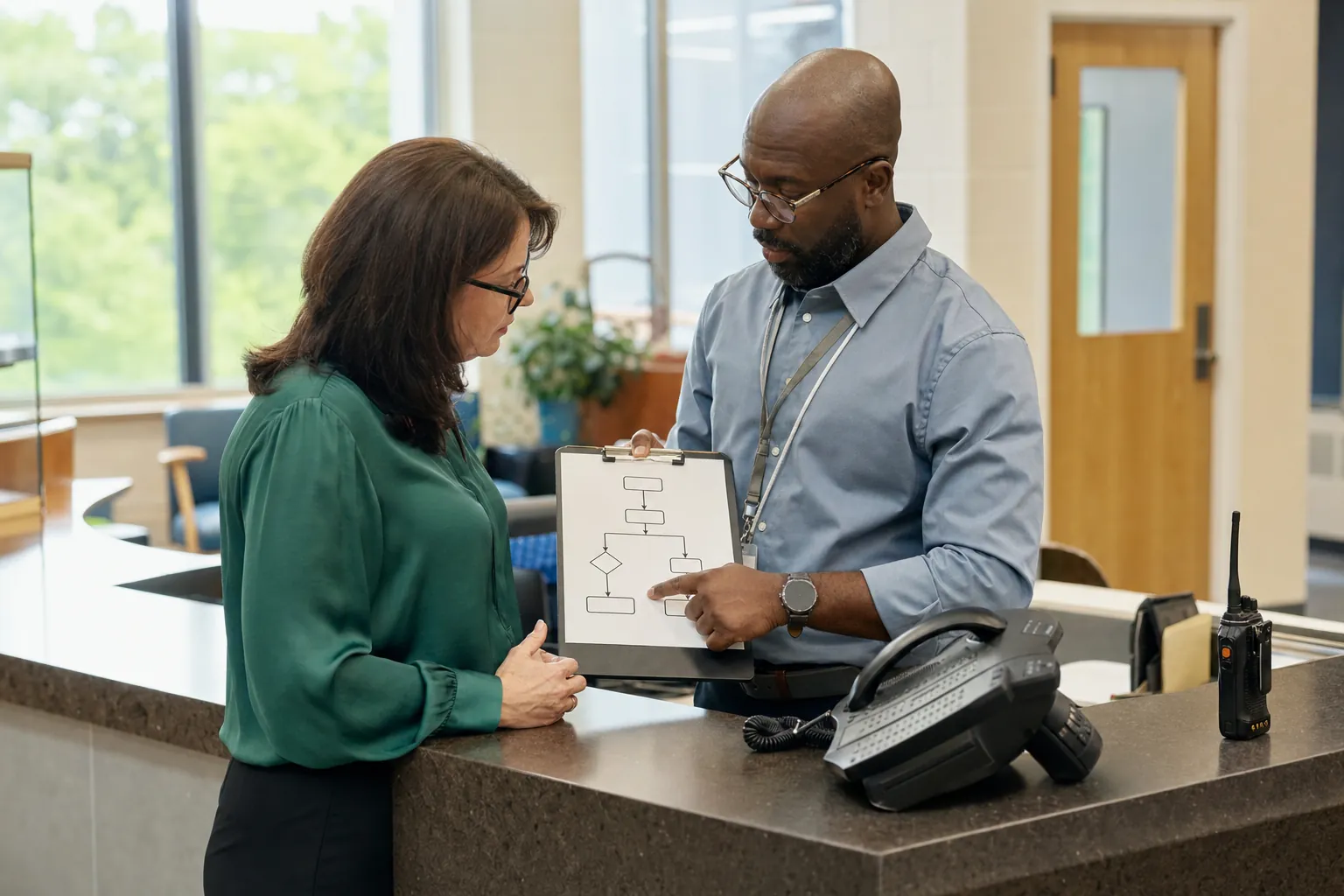
Most team members will not see the first sign of concern. A teacher, bus driver, coach, front-office colleague, student, or family member may be the first person who notices a change, hears a statement, receives an online message, or sees a conflict beginning to grow. Training should show people exactly what to do with that information.
Keep the direction concrete: use the school’s approved reporting pathway, share what was observed or received, note timing and context when known, and avoid drawing conclusions beyond the facts. This helps the team begin with reliable information rather than rumor. It also protects staff from feeling they must decide alone whether a concern is “serious enough.”
Staff should understand the boundary between an immediate emergency and a concern that needs prompt review. In an immediate danger, follow the school’s emergency response procedures. In other situations, the goal is to connect the concern to trained people without delay. The existing threat assessment guide explains why a structured response considers behavior and context rather than relying on stereotypes, labels, or a single isolated detail.
Practice with scenarios, not private cases
People learn a process by using it. Short tabletop exercises give a team the chance to walk through roles, communication, information gathering, and follow-up without using a real student’s private situation. A scenario might begin with a vague report from a peer, a concerning online message, repeated conflict, or a significant change in a student’s behavior. The point is not to create a dramatic exercise. It is to reveal where the system needs clarity.
Keep a practice scenario focused. Ask: How does the report arrive? Who is notified? What information is relevant? Which role contacts whom? What support or safety options might the team consider under its policy? How is the next review date set? Pause at each handoff. If a participant has to guess, the process needs a clearer tool, a named backup, or more practice.
The U.S. Secret Service’s guidance on aligning behavioral threat assessment with student support systems emphasizes training for people involved in the process. Scenario practice helps a team connect prevention, intervention, and management instead of treating them as separate efforts.
Connect training to support, not only security
Threat assessment training should prepare people to ask what support, intervention, accountability, or safety measure will help next. It should not create an automatic path from concern to punishment. A student may need counseling, conflict support, family partnership, academic help, supervision changes, restorative steps, an outside referral, or another proportionate response under school policy.
This is where multidisciplinary perspectives matter. A concern may look different to an educator who sees a student every day, a counselor who understands support needs, an administrator responsible for school operations, and a liaison who knows local emergency protocols. Training should help the team bring those perspectives together without making assumptions about identity, disability, background, or diagnosis.
For leaders reviewing the conditions that make these handoffs work, a school safety audit can identify gaps in communication, roles, and daily routines. The broader school safety plan gives the team the framework for readiness, response, and recovery. Threat assessment training is one focused part of that larger system.

Review the process after training
Training is complete only when the school has a way to learn from it. End each session by identifying what was clear, what created hesitation, and what should change. The answer might be a revised contact list, an easier reporting form, a clearer role description, an additional team member, a translated family resource, or a scheduled tabletop exercise.
Use a simple review rhythm. New team members need onboarding. Established members need refreshers when policy, staffing, technology, or local requirements change. After an exercise or a case, the team can review the system without revisiting private details: Were the roles clear? Did information reach the right person? Did the team have the time and tools it needed? What one improvement should be owned before the next concern arises?
The National Center for School Safety’s team-training guidance also points to the importance of broader education and case-management preparation. A sustainable program makes room for both, rather than assuming a single session will cover every need.
Make documentation part of the practice
Documentation deserves direct attention in training because it is where a thoughtful conversation becomes a coordinated plan. Team members should understand what their local process requires them to record, who can access the record, how information is shared appropriately, and how a future review will show whether the agreed actions happened. District policy, student-record rules, and local legal guidance should direct the details.
Practice the difference between a factual observation and an assumption. “A student told a teacher about a message received at 2:15 p.m.” is different from a conclusion about intent. Clear records help the team preserve context, explain the actions it chose, and make a safe handoff when another trained person needs to step in. They also reduce the risk that a concern is passed through informal conversations with no accountable next step.
Give participants a simple, approved example to walk through during training. It can show the basic flow: report received, immediate safety question considered, relevant information gathered, actions assigned, support and communication steps identified, and review date scheduled. Do not use real student names or private cases. The value comes from learning the discipline of a clear process, not from reenacting someone’s difficult moment.
Leave training with a 90-day readiness plan
The best next step after training is usually modest and visible. Rather than attempting to redesign every safety policy at once, choose the few improvements that will make the process easier to use this term. A team might confirm its membership and backups, publish the reporting route for staff, schedule one tabletop exercise, review how new employees receive orientation, and set a date to revisit the results.
Write each action in plain language with an owner and a date. For example: the principal confirms team contacts by Friday, the student-support lead reviews the referral pathway before the next staff meeting, and the operations lead schedules a 30-minute tabletop before the semester ends. This does not turn training into a checklist exercise. It gives the school a way to turn learning into responsible follow-through.
As the work matures, leaders can ask more useful questions: Can a new staff member explain where to report a concern? Can a team member describe their role without opening a binder? Can a family find the right next step? Are supports and safety measures reviewed when circumstances change? Those questions keep the focus on readiness that people can actually use.
How Dr. Spells helps teams build readiness
Dr. Spells brings experience across education, public safety, law, policy, leadership, and community work to conversations that need clear thinking and care for people. His school safety training helps teams strengthen shared awareness, communication, and follow-through around the routines that protect learning.
For a closer look at how roles, reporting, and daily practices work in a specific setting, a school safety assessment can help leaders identify what is clear and what needs attention. When a district needs sustained work around a live challenge, school safety consulting offers a tailored path forward. Teams ready to discuss their setting can start a booking inquiry.
Frequently Asked Questions
Questions leaders ask about threat assessment training.
Who needs school threat assessment training?
Everyone with a defined role needs training that fits that role. Core team members need a shared, approved process and practice applying it. Staff, students, and families need to know how to report a concern and what happens next. Local policy and state requirements determine the specific training a school must use.
How often should a school threat assessment team train?
Follow state and local requirements first. Beyond required training, a team benefits from regular refreshers, onboarding for new members, and short tabletop practice that tests a real handoff or decision point. Training should be revisited after staffing changes, policy changes, exercises, or a case that reveals a gap.
Is school threat assessment training the same as active shooter training?
No. Threat assessment training focuses on a structured, team-based process for receiving concerns, gathering information, assessing context, planning support and safety measures, and following through. Emergency-response training has a different purpose. Both should align with the school’s approved plans and local procedures.
What should staff do if they are worried about a student?
Staff should use the school’s established reporting pathway, share specific observations, and avoid trying to investigate or manage a serious concern alone. Immediate danger requires the school’s emergency procedures. Other concerns should move promptly to the trained people responsible for assessment and support.
Related reading
Keep the work moving.
School Safety Measures That Protect Learning, Too
A practical framework for choosing, testing, and improving school safety measures without losing sight of the people they serve.
Read the guide
How to Build a School Safety Plan That Works
A step-by-step guide for school leaders building a safety plan people can understand, practice, and improve.
Read the guide
A School Safety Checklist for the Work That Matters
A practical school safety checklist for reviewing routines, communication, access, connection, and follow-through.
Read the guide